Chatbase Review: Pricing and Verdict, 2026
Short answer: Chatbase is a hosted platform for AI customer service agents. On monthly billing it costs $0 (Free, 50 message credits), $40 (Hobby, 700 credits), $150 (Standard, 4,000 credits) or $500 (Pro, 15,000 credits) per month, 20% less billed annually. Helpdesk, voice and API access start on Standard. We rate it 4.2 out of 5. Verified 2026-10-04 against chatbase.co/pricing and the Chatbase docs.
This page is the reference sheet for the Chatbase cluster: specs, plan limits, credit costs and recent changes, with links to every deeper guide. For a narrative walkthrough, read the Chatbase review on the blog.
Build your first Chatbase agent free, or start a 7-day trial on Hobby, Standard or Pro.
Chatbase at a glance
| Spec | Detail (verified 2026-10-04) |
|---|---|
| What it is | Hosted AI customer service agents built from business knowledge, instructions, actions and procedures |
| Price | Free $0; Hobby $40/month; Standard $150/month; Pro $500/month; Enterprise custom. Annual billing is 20% off |
| Free plan | 50 message credits/month, 1 agent, 0 AI actions, 1 MB training content, 1 seat; agents deleted after 14 days of inactivity |
| Trial | 7-day trial on Hobby, Standard and Pro |
| Credit cost per reply | 1 credit on Auto and lightweight models, up to 6 on top-tier models; actions can double it |
| Channels | Website widget or iframe, hosted help page, email, WhatsApp, Messenger, Instagram, Slack, Shopify, WordPress, voice and phone, API |
| Human handoff | Built-in Helpdesk with live chat handoff and escalation tickets (Standard and up) |
| Voice | Real-time voice, Twilio or your own SIP trunk; 10 concurrent calls on Standard, 20 on Pro |
| API | API v2 with streaming responses (Standard and up) |
| Languages | 80+ with automatic detection, per Chatbase's homepage |
| Security | SOC 2 Type II, GDPR; no training on customer data on any plan; HIPAA only on Enterprise via a BAA |
| Our rating | 4.2 / 5 |
Chatbase guides on this site
| Guide | What it answers |
|---|---|
| Chatbase review | Narrative review: features, setup flow, strengths and gaps |
| Chatbase pricing | Every plan, add-on and credit rule, with costed scenarios |
| Chatbase API guide | API v2 endpoints, streaming, pagination and rate limits |
| Chatbase vs Tidio | Which to pick for small-business live chat and AI replies |
| Chatbase vs Voiceflow | Hosted support agent vs a visual conversation-design tool |
| Chatbase vs Botpress | Chatbase against Botpress, eesel AI and Intercom Fin |
| Chatbase alternatives | Other tools to consider, by use case |
| Best AI chatbot builders | The wider roundup of AI chatbot platforms |
What changed recently
From the Chatbase changelog, checked 2026-10-04:
| Date | Change |
|---|---|
| 2026-10-03 | GPT-6.1 Sol model added, at 2 credits per response |
| 2026-10-02 | Procedures: SOP-style repeatable workflows (trigger, ordered steps, branches, action calls) |
| 2026-09-23 | MCP connector for Claude and ChatGPT; access expires after 90 days, delete and export are off by default |
| 2026-09-23 | Shopify: order creation from chat, exchanges with human approval, image product search, damaged or missing item replacements |
| 2026-09-23 | Search and filter conversations by text and by action |
Quick verdict
Choose Chatbase if:
- you want an AI support agent that ships quickly on a website, help page, email, or messaging apps
- you want the agent to take actions (orders, refunds, billing, bookings) and follow step-by-step procedures
- you want AI and human agents in one place, with live handoff to the built-in Helpdesk
- you want voice or phone support from the same agent (Standard and up)
Skip Chatbase if:
- you need a fully custom agent runtime with code-first orchestration
- your support team already lives in Zendesk or Freshdesk and wants the AI inside that tool rather than a separate inbox
- your main job is web scraping or data extraction rather than support automation
What does each Chatbase plan include?
Plan limits from the public Chatbase pricing page, verified 2026-10-04. Plans change, so confirm before you buy.
| Limit | Free | Hobby | Standard | Pro | Enterprise |
|---|---|---|---|---|---|
| Monthly billing | $0 | $40/month | $150/month | $500/month | Custom |
| Annual billing | $0 | $32/month ($384/year) | $120/month ($1,440/year) | $400/month ($4,800/year) | Custom |
| Message credits / month | 50 | 700 | 4,000 | 15,000 | Custom commit |
| Test credits / month | Not listed | 200 | 500 | 1,000 | Custom |
| AI agents included | 1 | 1 | 1 | 1 | Higher limits |
| AI actions per agent | 0 | 5 | 8 | 12 | Higher limits |
| Training content | 1 MB | 10 MB | 20 MB | 40 MB | Higher limits |
| Seats | 1 | 2 | 3 | 5 | Higher limits |
| Models | Limited | Advanced | Advanced | Advanced | Advanced |
| Integrations and channels | WordPress only | Adds Shopify, Slack, WhatsApp, Messenger, Instagram, Calendly | Adds Zapier, Twilio, Stripe, Zendesk, Salesforce, Intercom, HubSpot | Same as Standard | Same as Pro |
| Helpdesk and live handoff | No | No | Yes | Yes | Yes |
| Voice and telephony | No | No | Yes, 10 concurrent calls | Yes, 20 concurrent calls | Yes |
| API access | No | No | Yes | Yes | Yes |
| Other additions | Attachments, basic analytics | Outbound campaigns, personalization, auto-resync of sources | Advanced analytics, source suggestions, tickets as a training source | SSO, custom roles, white-labeling, audit logs, SLAs, HIPAA-eligible |
Training content is measured as extracted text, not file size.
Add-ons: auto-recharge credits at $40 per 1,000 message credits (these do not expire), extra AI agents at $25 per agent per month, and removing the "Powered by Chatbase" branding at $99/month. For costed scenarios that combine these, see Chatbase pricing.
How many credits does a Chatbase reply use?
Each request to the AI model costs credits according to the model you pick (source: Chatbase models comparison docs, checked 2026-10-04):
| Credits per request | Models |
|---|---|
| 1 | Auto, GPT-6 Luna, GPT-5 Mini, GPT-4o Mini, Claude 4.5 Haiku, Gemini 3 Flash, DeepSeek, Llama |
| 2 | GPT-6.1 Sol, Claude 5.5 Sonnet, Gemini 3.6 Flash, Gemini 3.1 Pro, GPT-5.2 |
| 3 | Claude 4.6 Sonnet, Grok 3 |
| 4 | GPT-5.5, Grok 4 |
| 5 | Claude 5.5 Opus |
| 6 | Claude 4.7 Opus, Claude 4.8 Opus |
| Voice | 6 credits per minute, plus the normal model credits per reply |
If the agent calls an action, one customer message can trigger two or more model requests. So Standard's 4,000 credits are roughly 4,000 replies on a 1-credit model, about 2,000 on a 2-credit model, and fewer when actions run. Subscription credits reset on the 1st of each calendar month and do not roll over.
What Chatbase does well
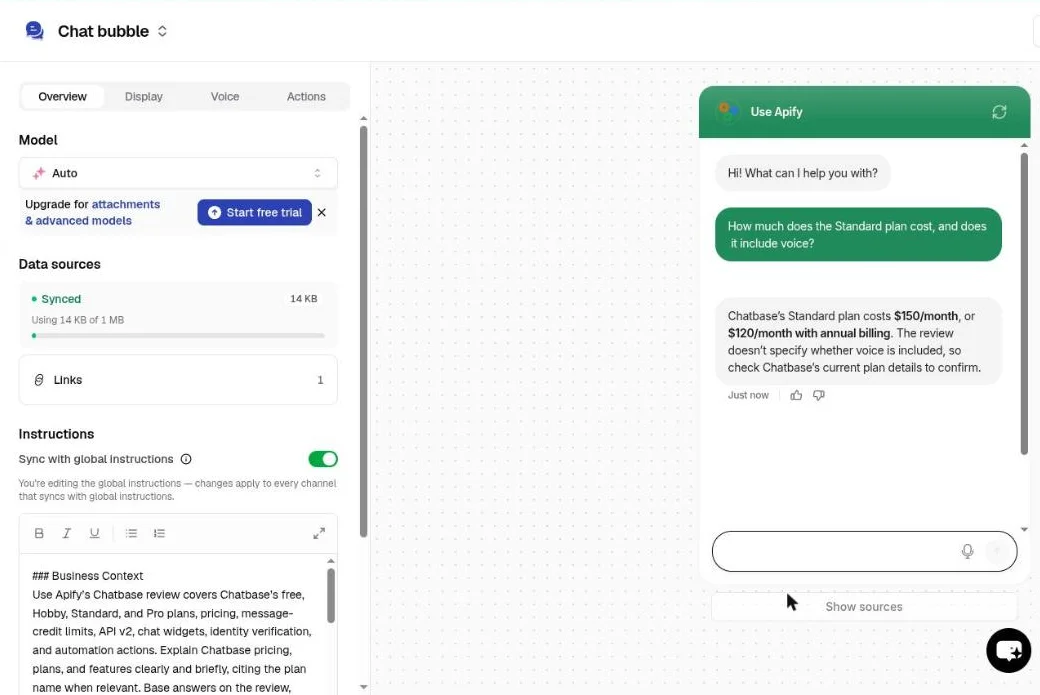
The Chatbase Playground on the Free plan, from our test agent on 2026-10-04. The Chatbase review walks through setup and the deploy screens.
Each agent is built from four blocks: business knowledge (docs, website, files, help-center content and, on Pro, past tickets), instructions (persona, system prompt, model, temperature), actions (Shopify orders and returns, Stripe billing, Cal.com or Calendly booking, lead capture, custom API calls, web search, handoff) and procedures (SOP-style workflows of up to 15 steps with up to 5 branches per decision, for refunds, escalations or onboarding). Around that:
- Deployment: the JavaScript widget is the recommended embed; an iframe is simpler but drops advanced features. A hosted help page can run on your own subdomain. WordPress has an official plugin and Shopify adds the bubble without code.
- Built-in Helpdesk (Standard and up): a ticket inbox across bubble, email, WhatsApp and API, with assignment, internal notes and takeover of AI conversations. The live chat action hands a conversation to a human in real time while the customer stays in the widget; the escalation action opens a ticket instead.
- Voice and telephony (Standard and up): real-time voice, inbound calls through Twilio or your own SIP trunk, outbound campaigns, and a transfer action that forwards a live call to a human.
- API v2 with Server-Sent Events streaming, cursor-based pagination, and published rate-limit headers with
Retry-After. - Contacts and identity verification for replies that reflect account context.
- Accuracy controls: temperature from 0 to 1 (default 0), a Compare view to test settings side by side, and "Revise answer" in Activity, which stores a corrected Q&A as a source.
- Integrations and handoff to Zendesk, Intercom, HubSpot, Freshdesk, Salesforce and others.
Chatbase states that it does not train AI models on customer data, on any plan.
If those limits and features fit your volume, compare Chatbase plans and pick the tier that matches the channels you need.
Chatbase pros and cons
| Pros | Cons |
|---|---|
| Agents resolve requests with knowledge, instructions, actions, and procedures | No code-first agent runtime for developer-owned orchestration |
| Built-in Helpdesk with live AI-to-human handoff | Helpdesk, voice, telephony, and API start on Standard, not the cheaper tiers |
| Voice agents and phone calls from the same agent | Separate inbox if your team already works in Zendesk or Freshdesk |
| Broad integration list: Stripe, Slack, Zendesk, Salesforce, Shopify | Credits are model-dependent, so premium models drain lower plans quickly |
| Transparent self-serve pricing with a 20% annual discount | Free-plan agents are deleted after 14 days of inactivity |
Best use cases
- Support teams that want a fast launch: deploy a widget, then add actions, procedures and handoff into the built-in Helpdesk.
- Authenticated experiences: identity verification and contact data let replies reflect the logged-in user's account.
- Repeatable support workflows: actions look up orders, process returns, check billing or book meetings, and procedures chain them into SOPs with branches.
- One agent across chat and phone: on Standard and up, the same agent handles voice calls and forwards a live call to a human when needed.
Where Chatbase is weaker
Not ideal for teams that want code-first agent control
Botpress is the better fit when the implementation needs custom code, deeper agent orchestration, or a developer-owned runtime. See Chatbase vs Botpress.
Not ideal if your team already lives in another helpdesk
Chatbase has its own Helpdesk and integrates with Zendesk, Freshdesk, and others, but if your support team is committed to Zendesk, Freshdesk, or Confluence and wants the AI to work natively inside that tool, eesel AI or Intercom Fin may be a better operational fit.
Not ideal if your main need is the data layer
If you are building the ingestion pipeline behind a chatbot, start with the data layer first. Apify's Data for AI & RAG guide is the better place to begin.
Alternatives by use case
| If you need… | Consider… | Why |
|---|---|---|
| More developer control | Botpress | Stronger fit for code-heavy agent builds and custom runtime logic |
| AI inside your existing helpdesk | eesel AI | Built to work inside helpdesks such as Zendesk and Freshdesk |
| A customer-service suite with AI agent depth | Intercom Fin | Strongest when you want an AI agent inside a support suite |
| The data ingestion layer behind the bot | Apify Data for AI & RAG | Better for crawling, cleaning, and exporting source content |
For a wider list, see Chatbase alternatives.
How we researched this
We checked chatbase.co/pricing, the Chatbase docs (channels, models comparison, Helpdesk, voice settings, workspaces, security) and the Chatbase changelog on 2026-10-04. Figures on this page come from those sources. We did not run load or accuracy benchmarks, and the 4.2 rating is our editorial judgement.
FAQ
Yes, if you want hosted AI customer service agents that use your business knowledge, instructions, actions, and procedures to resolve requests, with a built-in Helpdesk for human handoff and voice support on Standard and up. It is less compelling if you need code-first runtime control or want the AI to live inside an existing helpdesk such as Zendesk. We rate it 4.2 out of 5.
On monthly billing: Free $0 (50 message credits), Hobby $40/month (700 credits), Standard $150/month (4,000 credits), and Pro $500/month (15,000 credits), plus custom Enterprise. Annual billing takes 20% off: $32/month ($384/year), $120/month ($1,440/year), and $400/month ($4,800/year). Add-ons include extra agents at $25/month and branding removal at $99/month. Check chatbase.co/pricing for current numbers.
It depends on the model. Auto and lightweight models such as GPT-6 Luna or Claude 4.5 Haiku cost 1 credit per request, mid-tier models such as GPT-6.1 Sol or Claude 5.5 Sonnet cost 2, and top models cost up to 6. Actions can add a second model request per message, and voice uses 6 credits per minute on top of model credits.
It is fine for a quick trial: 50 message credits per month, one agent, limited models, no AI actions, and 1 MB of training content. Helpdesk, voice, and API access are not included, and WordPress is its only integration. Free-plan agents are deleted after 14 days of inactivity. Hobby, Standard, and Pro offer a 7-day trial instead.
Yes. Chatbase API v2 is a public REST API with streaming responses, conversation endpoints, cursor-based pagination, and rate limit headers. API access starts on the Standard plan at $150/month, or $120/month billed annually ($1,440/year). Standard also unlocks the Helpdesk, voice, and telephony.
Yes, on the Standard plan and up. Agents hold real-time voice conversations and answer phone calls through Twilio or your own SIP trunk, with 10 concurrent calls on Standard and 20 on Pro. A transfer action forwards a live call to a human. In chat, the live chat action hands the conversation to a human in Chatbase's built-in Helpdesk in real time.
Hobby ($40/month) is the first plan with WhatsApp, Messenger, Instagram, Slack, and Shopify. The Free plan only offers WordPress among integrations. Zapier, Twilio, Stripe, and helpdesk integrations such as Zendesk start on Standard. On WhatsApp, Meta includes 1,000 free messages per month, then bills you directly.
No. Chatbase says it does not train AI models on customer data on any plan, and its model providers cannot train on it either. The platform is SOC 2 Type II and GDPR compliant, with data encrypted at rest and in transit. HIPAA support is available only on Enterprise, through a BAA with zero data retention.
Botpress for code-first agent control, eesel AI for AI that works inside an existing helpdesk, and Intercom Fin for an AI agent inside a full support suite. Our Chatbase vs Botpress, eesel AI, and Intercom comparison covers the trade-offs, and the Chatbase alternatives post lists more options by use case.
Use Apify to crawl and structure the source content, such as help-center pages, product catalogs, or documentation, then pair it with a chatbot platform like Chatbase for the conversation, actions, and support workflow layer. Our Data for AI and RAG guide shows how to build that ingestion pipeline.
If the limits above fit your volume, start your Chatbase agent on a 7-day trial. Billing is month-to-month, so you are not locked into the annual rate just to try it. If you need the Helpdesk, voice, or the API, those start on Standard. If your team already runs on another helpdesk, read "Where Chatbase is weaker" above before you sign up.